6

Regional Differences in Ethnicity and Language in Ukraine

Note: I now have a new post on Ukrainian political geography complete with an interactive graphic.

If you’ve been following the news, you know that Ukraine is experiencing mass protests and civic unrest. The situation seems to be coming to a head today, with riot police threatening to break up demonstrations in Kyiv and President Viktor Yanukovych talking about meeting with opposition leaders. The protests were triggered when Yanukovych backed out of signing an agreement with the European Union that would increase trade and political cooperation. Things got worse when police beat some unarmed protesters last week. Ukrainians are generally fed up by lack of economic opportunity as well as pervasive corruption, and many seem happy to take to the streets.

Why would Yanukovych refuse to sign the EU agreement after previously promoting it, knowing that it would make a lot of Ukrainians unhappy? Well, the standard answer is that Russia put enormous pressure on Ukraine, including threatening economic retribution. And that’s true. But to grasp why Yakukovych felt comfortable making this decision, and why Russia has such an outsized influence on the country, you have to understand how Ukraine is ethnically, culturally, and linguistically divided  by geography.

Ethnicity

The map above shows the percent of ethnic Russians in each of Ukraine’s oblasts (regional administrative units. About 17 percent of Ukrainians identify as ethnic Russian (2001 census), but they are clustered in the east and south of the country. There is a very sharp drop off in the number of Russians to the north and west of this dividing line, for example from 25.6%  in Kharkov Oblast to 7.2% in Poltava Oblast. There are many historic reasons for this ethnic divide, including migration from Russia in Soviet times to industrial regions in eastern Ukraine, but we won’t get into that now.

Language

Percent of Ukrainians by Oblast whose native language is Russian. About 30 percent of Ukrainians identified as native Russian speakers.

But ethnicity is really only a minor part of the story. The map above shows the percentages of Ukrainians whose native language is Russian. Again you can see the stark divide separating south and east from the rest of the country. Comparing with the ethnicity map you can also see that many Ukrainians who are not ethnic Russians speak Russian as their native language.

Dominant language at the raion (sub-regional) level in Ukraine. Blue is Ukrainian. Red is Russian.

When you look closer, at the sub-regional level, you can actually see that Russian language is concentrated in Crimea and in the large cities and industrial areas of the south and east. Rural areas in the east are predominately Ukrainian speaking. This reminds me of election maps in the United States where Democratic votes are concentrated in dense urban areas, meaning that the map might be awash in a sea of Republican red even if the Democrats won.

Politics

Percent of the vote by region captured by Viktor Yanukovich in the 2010 presidential election.

This ethnic and linguistic divide coincides with a cultural and political divide. The map above shows how much of the vote Yanukovich got in each region in 2010. Even though the election was decided by only about 3.5%, Yanukovych didn’t even get 10% in some areas of western Ukraine while he carried over 90% in Donestk Oblast (where he is from) in the east. That’s a geographically divided electorate!

Eastern and southern Ukraine, especially urban areas, are ethnically, linguistically, and culturally closer to Russia than the other parts of the country. This divide is stark. In my experience as a Peace Corps volunteer working in all-Ukraine summer camps, it was not uncommon for many of the young people to have never met someone from the “other” region. Yanukovych and his Party of Regions have their power base in the east and south, and their supporters are much less likely to be upset at forgoing closer relations with the EU, and much more likely to favor closer relations with Russia. Moreover, the economic threats allegedly made by Putin would have affected the pro-Yanukovich regions more because they are industrial areas that sell lot of goods to Russia.

What next?

So Yanukovych choose a course of action that paralleled the wishes of his power base and his geographic region of support. It remains to be seen whether this was a wise political decision for him, but at this point it does not look good.

Perhaps Yanukovych overestimated the cultural and linguistic divisions in Ukraine, and did not account for the fact  people all over the country are unhappy with the regime, generally perceived as corrupt and ineffectual, and with the economic situation in the country as a whole.

Update: Just an couple hours after I posted this, the Washington Post WorldViews blog published this article. It makes many of the same points regarding the ethnic and liguistic divides in Ukraine and includes some interesting recent polling on the EU integration agreement.

2

Snow Up Close

It’s snowing here in the Washington DC area. Well, it’s actually spitting down freezing rain after a few flakes this morning, but that’s about you can expect in this area. But it was also the first time my young son had ever seen snow, and he thought it was pretty darn cool. And snow is pretty darn cool! If you’re a jaded adult perhaps it helps to take a closer look. Check out this image of a snowflake taken by an amateur photographer in Moscow named Alexey Klyatov. It’s stunning (and of course totally unique), and it was taken with a clever jerry-rigged system on his balcony. This Atlantic Magazine article explains how he did it. So enjoy the snow!

photo by Alexey Klyatov

1

Swiss Railways Diagram

One of the great things about Switzerland is its passenger rail system. Service is frequent and convenient, and the network is dense so you can get almost anywhere in the country by train. And you can even ride the rails high into the Alps on the many cog wheel railways and funiculars. But Swiss railways really outdid themselves with this rail service diagram. If you download the full sized version (and you should) and zoom in, you will see that the diagram contains train arrival times for every station pictured (for those train services that run daily). With only a copy of this diagram you’d have all the information you needed to navigate the entire Swiss rail network, although you might need a magnifying glass to read the small print. The Human Transit blog explains how to read the notation.

Swiss railways

2

Visualizing where our energy comes from (and where it goes)

Lawrence Livermore National Laboratory produces fantastic annual diagrams that show energy flow in the U.S. from source to end use. Here’s the latest one, from 2012. You can learn a lot from studying this, but here are a few insights that were interesting to me:

  • Almost 2/3 of total energy is not used for productive work (energy services). Most of this is probably from waste heat. Our transportation sector is particularly wasteful, which I guess is what happens when most people have their own internal combustion engine to propel them at high speeds over vast distances every day.
  • Petroleum is used mostly for transportation (i.e. gasoline), with some going to industry (not sure what this would be).
  • Coal is still the biggest source of electricity, although if you look at diagrams from earlier years you can see that it is decreasing at the expense of natural gas, and to a less extent, wind and solar.

Where does it come from and where does it go?

0

Tornadoes Over Time with CartoDB

Yesterday I participated in an online introductory class about CartoDB, a new mapping tool with a great look and feel and a solid free option. Although I had dabbled with CartoDB before, this class got me excited about it. In particular, a new tool called torque that allows you to make animated geovisualizations is really cool.

One project we did in the class was creating an animation of tornadoes touching down in the U.S. over time. My animation shows 10 years of data in about 15 seconds. You can clearly see a pulse of tornadoes each year that begins in the south in the spring, and moves northwest as the summer progresses. Meanwhile, Florida shows tornado activity pretty much year round. Making the map took about 20 minutes. Here it is:

tornadoes over time

click on the image to see the animation

1

Using Tableau Public to Make an Interactive Visualization

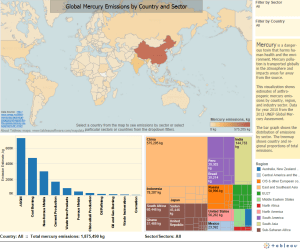
Dashboard_1 For the last several weeks I’ve been experimenting with Tableau Public, a powerful, free software package for data analysis and visualization. I’m impressed by the software. It’s certainly the best free product I’ve worked with.

My big project on Tableau is an interactive graphic showing global mercury emissions by country and sector. I was able to get a nice dataset from the Arctic Monitoring and Assessment Program. These data were part of the 2013 UNEP Global Mercury Assessment. So they are very up-to-date, and with the adoption of the new Minamata Convention on Mercury, the topic is quite relevant. Good ingredients for an nice viz.

The graphic combines three elements: 1) a world map showing mercury emissions by country in a color gradient scale, 2) a tree map showing the mercury emissions of regions and their constituent countries as a part of total global emissions, and 3) a bar graph showing the makeup of emissions by industry sector for the world or selected countries. All the elements are linked so that selecting objects in one changes the other elements.

Check it out.

0

Minamata Convention Word Cloud

I’m not usually a fan of word clouds. They’re flashy but don’t really tell you much, and they seem like a pretty lazy analysis that you do if you don’t know what else to say about a text. Having said that…this word cloud is actually pretty cool. The text is the Minamata Convention on Mercury and it was produced on wordle.com. It’s a visually pleasing color scheme and layout, but of course the real reason I like it is because the text is very close to my heart, as I’ve spend the last several years negotiating it together with 140 other governments. I like the idea that a text that represents such a huge amount of collective effort on the part of hundreds of people around the world can be represented in a little graphic like this.

Wordle: Minamata Convention on Mercury

1

First post

Welcome to the very first post of geovisualist. I’d like to start with with a problem that was actually what finally inspired me to start this blog. I have some data. The data consists of a list of about 40 countries with a number of fields related to mercury use in a particular industry. The exact nature of the data is not really important. It’s preliminary, but when I have finalized data I will describe it in more detail. What I’m interested is how these data can be displayed in a map format. I don’t have GIS software, so I’m looking to do this online in a way that’s easy, free, and looks good. So far I’ve found three tools. The first is Many Eyes, a project sponsored by IBM that let’s users post data and experiment with different visualizations (not limited to maps). I was able to make a nice interactive bubble marker map:
2012 Capacity

The next tool is called CartoDB. It’s exclusively for making map-based visualizations, and is a bit more slick that Many Eyes in that respect. Here’s the interactive bubble map.

Finally there’s Google Charts. This method uses ready made chart libraries that create a javascript interactive object that you can embed in a website. WordPress.com apparently does not like embedding javascript, but you can see what I created here.

Now, all of these tools were more in-depth than what I originally wanted to do with the data, which was create a map that I could publish as a simple image file. Still, the interactive nature of these visualizations is pretty neat. But I would still like to find a free tool that will let me display the data and export as a high-quality good looking still image.